Read the Rosie the Riveter Article here: Geraldine Hoff Doyle Dead: 'Rosie The Riveter' Inspiration Dies At 86
Thursday, March 31, 2011

Tuesday, March 22, 2011
WW2 Family Ties

This is a C-47 like the one my grandpa flew in during WW2.
In April 1942, pilots started flying the "Hump," and continued missions until 1945, when the Burma Road was reopened. The dangerous 530-mile long passage over the Himalayan Mountains took its toll. Combat Cargo Groups were soon on the way. The newly introduced units' sole purpose in the theater was to be air-resupply, supplying ground units in a combat zone.

My paternal grandfather, Luke Kriner during WW2.
Staff Sergeant in Army Air Corps 1943.

My grandpa "flew the hump" during WW2.
This is him in Burma in 1945.

My paternal grandfather, pictured with my brother and I.
L to R-Joshua Luke Kriner, Luther Milton Kriner, and Heather Dawn Kriner 1983
(1 year prior to his death)
Friday, March 11, 2011
3.11 Great Depression Wiki


Examine the pictures. As you do so, think about the fact, during the Depression, thousands of Americans lived as this family is living—without homes and with hope fading fast. Read Lange’s explanation of the situation in which she took these pictures.
ON THE WIKI, write the details from the pictures and Lange’s description that strike you in some way.
Make some personal response to those details.
Write a summary or a poem; pose questions; draw a picture; make some kind of personal connection to the visual and verbal information.
http://www.st.cr.k12.ia.us/webquest/Depression/Depression%20WebQuest.htm
Monday, January 31, 2011
2010-11 WWI: Interactive Poems
Read the World War I poems:

http://www.bbc.co.uk/schools/worldwarone/hq/flanders_field.shtml

http://www.bbc.co.uk/schools/worldwarone/hq/zeppelins.shtml
Reply to this post and tell me
1. Which poem was your favorite?
2. What did you like about it?

http://www.bbc.co.uk/schools/worldwarone/hq/flanders_field.shtml

http://www.bbc.co.uk/schools/worldwarone/hq/zeppelins.shtml
Reply to this post and tell me
1. Which poem was your favorite?
2. What did you like about it?
Monday, January 24, 2011
2010-11 WWI: Drafted!

This is my great-great grandpa's draft card from World War I. He was drafted when he was 26 years old and served from 1917-1918. He was a miller (a person who operates a mill, a machine to grind a cereal crop to make flour) and had no military experience.
**Think about what it means to be "drafted" into a war.
**Think about what it means to be "drafted" into a war.
Reply to this entry by responding to this question:
How would you feel if you got a draft card? Cite specific reasons why you feel this way.

Walter Kriner, my great, great grandpa.
Nice boots, huh?

My great grandpa's dad's farm in Dubois, Pennsylvania.
My great grandpa is the young man on the left leaning on the car.
How would you feel if you got a draft card? Cite specific reasons why you feel this way.

Walter Kriner, my great, great grandpa.
Nice boots, huh?

My great grandpa's dad's farm in Dubois, Pennsylvania.
My great grandpa is the young man on the left leaning on the car.

My great grandpa's family.
Do you see the little boy on the left (behind the boy in the sailor suit)?
That is my grandpa, Luke Kriner.
Thursday, January 20, 2011
20010-11 WWI: Trench Warfare Game

Go to this link and play the Trench Warfare game.
http://www.bbc.co.uk/schools/worldwarone/hq/trenchwarfare.shtml
Friday, January 14, 2011
Wednesday, January 12, 2011
2010-11 WWI Posters


Propaganda posters were used for:
-justifying a country's involvement in the conflict
-wartime rationing
-seeking funds and materials for war
-encouraging sales of war bonds (funds for war)
-recruitment of men


Saturday, October 30, 2010

Saturday, October 23, 2010
Amendments: 13, 14, 15
How are a citizen's rights protected by the 13th, 14th, and 15th amendments?


13th Amendment
The 13th Amendment comprises a very short statement that prohibits slavery, except for convicted criminals, and a short statement that allows Congress to pass laws to enforce this prohibition:
Section 1: Neither slavery nor involuntary servitude, except as a punishment for crime whereof the party shall have been duly convicted, shall exist within the United States, or any place subject to their jurisdiction.
Section 2: Congress shall have power to enforce this article by appropriate legislation.
This amendment was first introduced in the U.S. Senate early in 1864, when the war was still under way. The Senate passed the amendment in April 1864, but the House did not pass it until January 1865. After Lincoln was assassinated in April 1865, his successor Andrew Johnson made ratification of the 13th Amendment a requirement for readmission to the Union. Eighteen states ratified it very shortly after Congress formally approved it. After much delay by the former Confederate states, it was ratified by the minimum of twenty-seven of the thirty-six states on December 6, 1865.
The 13th Amendment comprises a very short statement that prohibits slavery, except for convicted criminals, and a short statement that allows Congress to pass laws to enforce this prohibition:
Section 1: Neither slavery nor involuntary servitude, except as a punishment for crime whereof the party shall have been duly convicted, shall exist within the United States, or any place subject to their jurisdiction.
Section 2: Congress shall have power to enforce this article by appropriate legislation.
This amendment was first introduced in the U.S. Senate early in 1864, when the war was still under way. The Senate passed the amendment in April 1864, but the House did not pass it until January 1865. After Lincoln was assassinated in April 1865, his successor Andrew Johnson made ratification of the 13th Amendment a requirement for readmission to the Union. Eighteen states ratified it very shortly after Congress formally approved it. After much delay by the former Confederate states, it was ratified by the minimum of twenty-seven of the thirty-six states on December 6, 1865.

14th Amendment
Despite reluctantly acceding to the core requirements for readmission to the Union, many of the former Confederate states began passing laws – the so-called "Black Codes" – that disenfranchised the former slaves economically and politically.
This drove the Republicans who controlled Congress to undertake stronger measures to impose their will on the defeated Southern states. The first of these came in the form of the 14th Amendment, a more detailed set of restrictions on the states than either of the other Civil War amendments. Its main points are summarized below:
Section 1: No state may abridge the privileges and immunities of any of its citizens, or deny them due process of law or equal protection of the laws.
Section 2: When any state denies the right to vote at any election to any of its male citizens of voting age, its representation in elections for national offices will be reduced in the same proportion. (Basically, if a state excludes African Americans, then it will be given proportionally fewer seats in the U.S. House of Representatives and fewer votes in the presidential electoral college.)
Section 3: No person who has engaged in or supported insurrection or rebellion against the United States may hold public office.
Section 4: All debts incurred in aid of insurrection or rebellion against the United States and all compensation claims made for emancipation of any slave will be held as illegal and void.
Congress proposed the 14th Amendment on June 13, 1866. More than two years later on July 28, 1868 the U.S. Secretary of State certified that it had been ratified by twenty-eight of the thirty-seven states.
In the intervening time, the Congressional elections of 1866 added to the strength of the Republicans, giving them the two-thirds majority in both houses of Congress needed to override any presidential veto. The Republicans began the new session in March 1867 by passing additional reconstruction laws (over President Johnson's veto), inaugurating a new period of much firmer treatment of the South known as the Radical Reconstruction. Congress divided the South into military districts and required the states to adopt new constitutions, provide for black suffrage, and ratify the (still un-ratified) 14th Amendment.
Despite reluctantly acceding to the core requirements for readmission to the Union, many of the former Confederate states began passing laws – the so-called "Black Codes" – that disenfranchised the former slaves economically and politically.
This drove the Republicans who controlled Congress to undertake stronger measures to impose their will on the defeated Southern states. The first of these came in the form of the 14th Amendment, a more detailed set of restrictions on the states than either of the other Civil War amendments. Its main points are summarized below:
Section 1: No state may abridge the privileges and immunities of any of its citizens, or deny them due process of law or equal protection of the laws.
Section 2: When any state denies the right to vote at any election to any of its male citizens of voting age, its representation in elections for national offices will be reduced in the same proportion. (Basically, if a state excludes African Americans, then it will be given proportionally fewer seats in the U.S. House of Representatives and fewer votes in the presidential electoral college.)
Section 3: No person who has engaged in or supported insurrection or rebellion against the United States may hold public office.
Section 4: All debts incurred in aid of insurrection or rebellion against the United States and all compensation claims made for emancipation of any slave will be held as illegal and void.
Congress proposed the 14th Amendment on June 13, 1866. More than two years later on July 28, 1868 the U.S. Secretary of State certified that it had been ratified by twenty-eight of the thirty-seven states.
In the intervening time, the Congressional elections of 1866 added to the strength of the Republicans, giving them the two-thirds majority in both houses of Congress needed to override any presidential veto. The Republicans began the new session in March 1867 by passing additional reconstruction laws (over President Johnson's veto), inaugurating a new period of much firmer treatment of the South known as the Radical Reconstruction. Congress divided the South into military districts and required the states to adopt new constitutions, provide for black suffrage, and ratify the (still un-ratified) 14th Amendment.
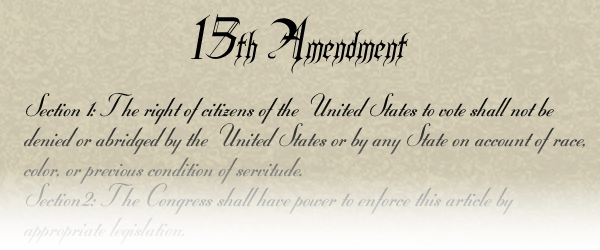
15th Amendment
The 15th Amendment to the U.S. Constitution was aimed directly at curtailing attempts by the former Confederate states to exclude former slaves from voting and at the persistent violence over their political participation. It contains two short sections that prohibit the denial of the right to vote and allow Congress to enforce this prohibition.
Section 1: The right of citizens of the United States to vote shall not be denied or abridged by the United States or by any State on account of race, color, or previous condition of servitude.
Section 2: The Congress shall have power to enforce this article by appropriate legislation.
The 15th Amendment was passed by Congress and submitted to the states for ratification on February 26, 1869 amid recurring bouts of violence against African Americans, particularly at polling locations.
Despite these incidents, the South was under much tighter Union control than earlier under the softer reconstruction in the immediate post-war period, and the ratification by the minimum three-fourths of the states was completed within a year. On March 30, 1870, the 15th Amendment was declared to have been ratified by the legislatures of twenty-nine of the thirty-seven existing states.
The 15th Amendment to the U.S. Constitution was aimed directly at curtailing attempts by the former Confederate states to exclude former slaves from voting and at the persistent violence over their political participation. It contains two short sections that prohibit the denial of the right to vote and allow Congress to enforce this prohibition.
Section 1: The right of citizens of the United States to vote shall not be denied or abridged by the United States or by any State on account of race, color, or previous condition of servitude.
Section 2: The Congress shall have power to enforce this article by appropriate legislation.
The 15th Amendment was passed by Congress and submitted to the states for ratification on February 26, 1869 amid recurring bouts of violence against African Americans, particularly at polling locations.
Despite these incidents, the South was under much tighter Union control than earlier under the softer reconstruction in the immediate post-war period, and the ratification by the minimum three-fourths of the states was completed within a year. On March 30, 1870, the 15th Amendment was declared to have been ratified by the legislatures of twenty-nine of the thirty-seven existing states.
Sunday, August 29, 2010
Civil War Website Treasure Hunt

Welcome to our Blog!
Here is a list to get you started today:
1. Write down your homework for the week in your agenda.
2. Leave your agenda open so Ms. Welch can sign it.
3. Do Now: Daily Science
4. Discuss with your group who will do what jobs for group inspired classroom lessons:
-operator (works the computer)
-recorder (writes down answers/information)
-reader (reads info from the source to the group)
-contributor(s) (help offer answers, advice to the group)
5. Work with your group.
Go to http://www.radford.edu/~sbisset/civilwar.htm and read through the site to answer questions #1-8 together.
Remember that everyone must agree on an answer before the recorder writes it down.Civil War Website Treasure Hunt

Welcome to our Blog!
Here is a list to get you started today:
1. Write down your homework for the week in your agenda.
2. Leave your agenda open so Ms. Welch can sign it.
3. Do Now: Daily Science
4. Discuss with your group who will do what jobs for inspired classroom lessons:
-operator (works the computer)
-recorder (writes down answers/information)
-reader (reads info from the source to the group)
-contributor(s) (help offer answers, advice to the group)
5. Work with your group.
Go to http://www.radford.edu/~sbisset/civilwar.htm and read through the site to answer questions #1-8 together.
Remember that everyone must agree on an answer before the recorder writes it down.
Thursday, July 22, 2010
Blog Rules

No, not the Blob, the BLOG (short way to say web log-an online journal of sorts).
We will now post our journals to our class blog:
http://welchsclass.blogspot.com
This will help us with our new classroom technology model
"Inspired Classrooms"
http://inspiredclassrooms.wikispaces.com/About+Inspired+Classrooms
Remember the rules:
1. Never use your name or another students name in our class blog. There could be a stranger who reads our blog and we don’t want them to know your name.
2. When commenting as a group, use your group name. Anytime you comment as a group, everyone has to agree on the response.
3. When commenting as an individual, use your initials. The kids in our class will know who you are, but strangers will not.
4. Anytime you comment, make sure to use kind words. It’s ok to disagree with someone else as long as you do it politely.
5. Your response should include proper grammar and capitalization. No text writing please.
5. Remember, because our blog is on the internet, you can comment from class, from the computer lab, from home, or any other computer that is connected to the internet. All comments go to Ms. Welch first for moderation, so they won’t always show up immediately.
KEEP IT POSITIVE!
We will now post our journals to our class blog:
http://welchsclass.blogspot.com
This will help us with our new classroom technology model
"Inspired Classrooms"
http://inspiredclassrooms.wikispaces.com/About+Inspired+Classrooms
Remember the rules:
1. Never use your name or another students name in our class blog. There could be a stranger who reads our blog and we don’t want them to know your name.
2. When commenting as a group, use your group name. Anytime you comment as a group, everyone has to agree on the response.
3. When commenting as an individual, use your initials. The kids in our class will know who you are, but strangers will not.
4. Anytime you comment, make sure to use kind words. It’s ok to disagree with someone else as long as you do it politely.
5. Your response should include proper grammar and capitalization. No text writing please.
5. Remember, because our blog is on the internet, you can comment from class, from the computer lab, from home, or any other computer that is connected to the internet. All comments go to Ms. Welch first for moderation, so they won’t always show up immediately.
KEEP IT POSITIVE!
Monday, March 8, 2010
WW2
Good Morning!
Choose one of the following to read and discover.
Leave a reply for Ms. Welch and tell her what you read and 3 (bullets) things you learned.

Hiroshima
http://teacher.scholastic.com/activities/wwii/hiroshima/index.htm

Attack on Pearl Harbor
http://teacher.scholastic.com/pearl/index.htm

Anne Frank:
http://teacher.scholastic.com/frank/index.htm

On the homefront:
http://teacher.scholastic.com/activities/wwii/ahf/index.htm
Choose one of the following to read and discover.
Leave a reply for Ms. Welch and tell her what you read and 3 (bullets) things you learned.

Hiroshima
http://teacher.scholastic.com/activities/wwii/hiroshima/index.htm

Attack on Pearl Harbor
http://teacher.scholastic.com/pearl/index.htm

Anne Frank:
http://teacher.scholastic.com/frank/index.htm

On the homefront:
http://teacher.scholastic.com/activities/wwii/ahf/index.htm
Sunday, December 13, 2009
2009-10 Great Depression Reflection
Group Leaders: Read the following blog to your group and allow them to view the photographs. Discuss your feelings about what you see as you go. Write an individual reflection on your paper to turn in to Ms. Welch. Remember, I want a reflection that is well thought out, expressive (tells me how you feel) and serious. Put yourself in their position; how would you feel?
 Dorothea Lange (May 26, 1895 – October 11, 1965) was a photographer best known for her Depression-era photographs. Her photographs humanized the tragic consequences of the Great Depression. (Info from Wikipedia)
Write the details from the pictures and Lange’s description and how they strike you in some way.
Make some personal response to those details.
Write a summary or a poem;
pose questions;
 Dorothea Lange (May 26, 1895 – October 11, 1965) was a photographer best known for her Depression-era photographs. Her photographs humanized the tragic consequences of the Great Depression. (Info from Wikipedia)
Examine the pictures. As you do so, think about the fact, during the Depression, thousands of Americans lived as this family is living—without homes and with hope fading fast. Read Lange’s explanation of the situation in which she took these pictures.


I saw and approached the hungry and desperate mother, as if drawn by a magnet. I do not remember how I explained my presence or my camera to her, but I do remember she asked me no questions. I made five exposures, working closer and closer from the same direction. I did not ask her name or her history. She told me her age, that she was thirty-two. She said that they had been living on frozen vegetables from the surrounding fields, and birds that the children killed. She had just sold the tires from her car to buy food. There she sat in that lean- to tent with her children huddled around her, and seemed to know that my pictures might help her, and so she helped me. There was a sort of equality about it. (From: Popular Photography, Feb. 1960).
pose questions;
draw a picture;
make some kind of personal connection to the visual and verbal information.
2009-10 The Dust Bowl


Look at pages 340-341 in your book (The Dust Bowl).
Look at pages 348-349 in your book (Elenor Roosevelt).
Choose a picture above or from your book.
Look at the captions in your book from these pages.
Write a story or song about one of these photos.
If you need more info use the computers to search.
Your story/song is due before class ends today.
-Ms. Welch
2009-10 Then and Now: Prices


Compare Prices During the Great Depression to Prices Today:
http://www.michigan.gov/hal/0,1607,7-160-15481_19268_20778-52530--,00.html
Work with your group and take turns to search how much items cost today compared to what they cost during the Great Depression in the 1930's.
Each person in your group should have a completed, identical chart to turn in to Ms. Welch.
http://www.michigan.gov/hal/0,1607,7-160-15481_19268_20778-52530--,00.html
Work with your group and take turns to search how much items cost today compared to what they cost during the Great Depression in the 1930's.
Each person in your group should have a completed, identical chart to turn in to Ms. Welch.
Tuesday, November 10, 2009

Monday, November 2, 2009


Subscribe to:
Posts (Atom)